Delphi Monitor, worked example
Inside a Delphi run
Delphi Monitor exists to win a brand one specific advantage: being the name an AI assistant recommends when a customer asks the questions that decide a purchase.
Buyers increasingly ask an assistant before they ask anyone else, and the answer they get is now the shortlist. Delphi measures where your brand sits in those answers, benchmarks you against the competitors you actually lose to, and then goes past the score to the part that matters, which is why you are or are not being recommended.
From there it hands you the interventions, ordered by what will move your position fastest, and closes the loop: you act, the next run measures whether it worked, and you see verifiable movement rather than a number that drifts. It reaches well past conventional SEO, AEO and GEO metrics, because the thing being measured is a recommendation rather than a ranking.
What a run answers
- Are we being recommended at all?
- Who is being recommended instead?
- Why them and not us?
- What should we do first?
- Did what we did work?
01Where you stand
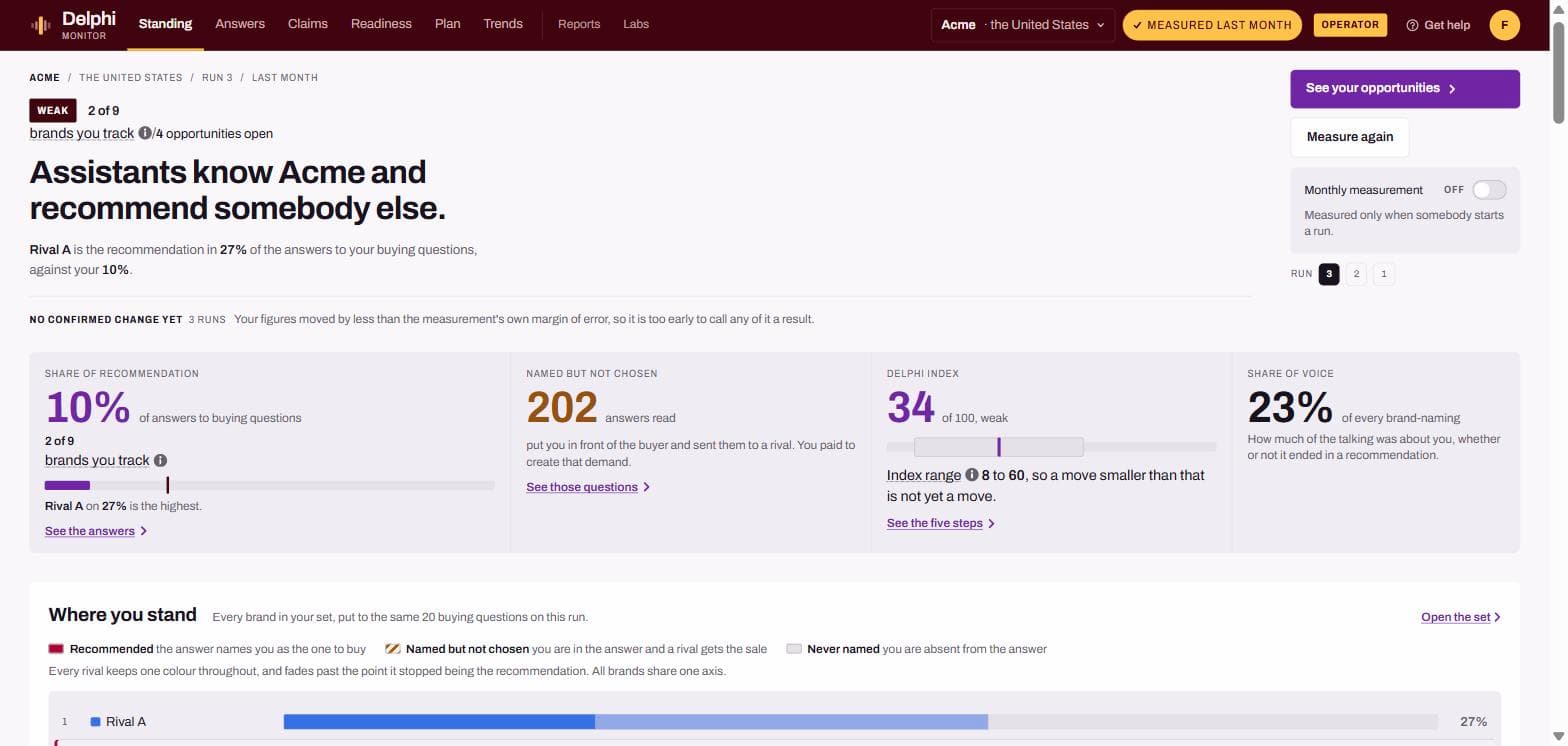
Assistants know Acme and recommend somebody else.
The opening screen answers the first question plainly: when a buyer asks what to get, how often is the answer you, and when it is not, who is it?
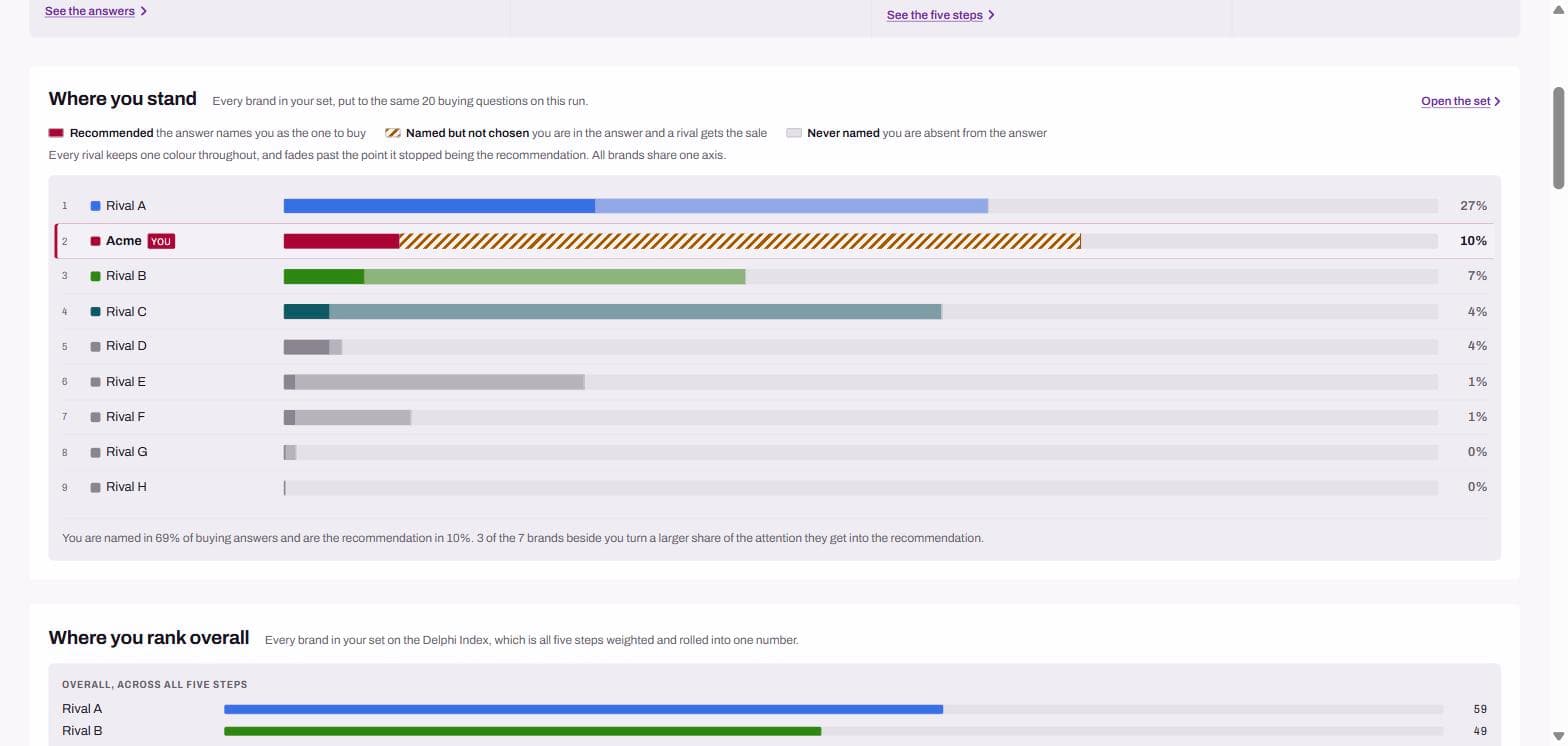
Being known turns out not to be the problem. This brand is mentioned in most buying answers and recommended in far fewer of them. Every one of those mentions put the brand in front of a buyer and then handed that buyer to a competitor. You paid to create that demand and somebody else banked it.
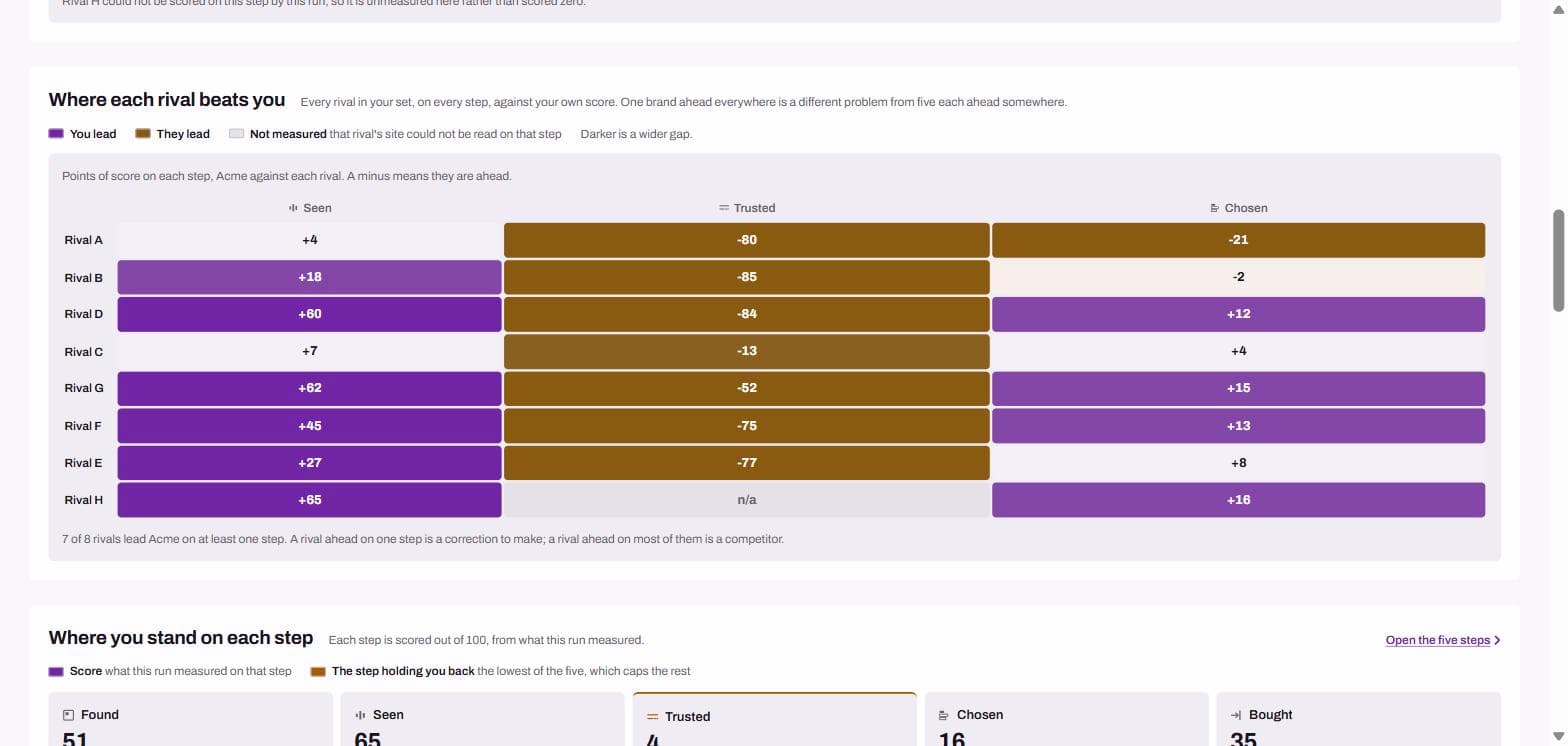
Alongside it, every competitor you track is put to the same questions, so your position is a place in a market rather than a number on its own.
02Why
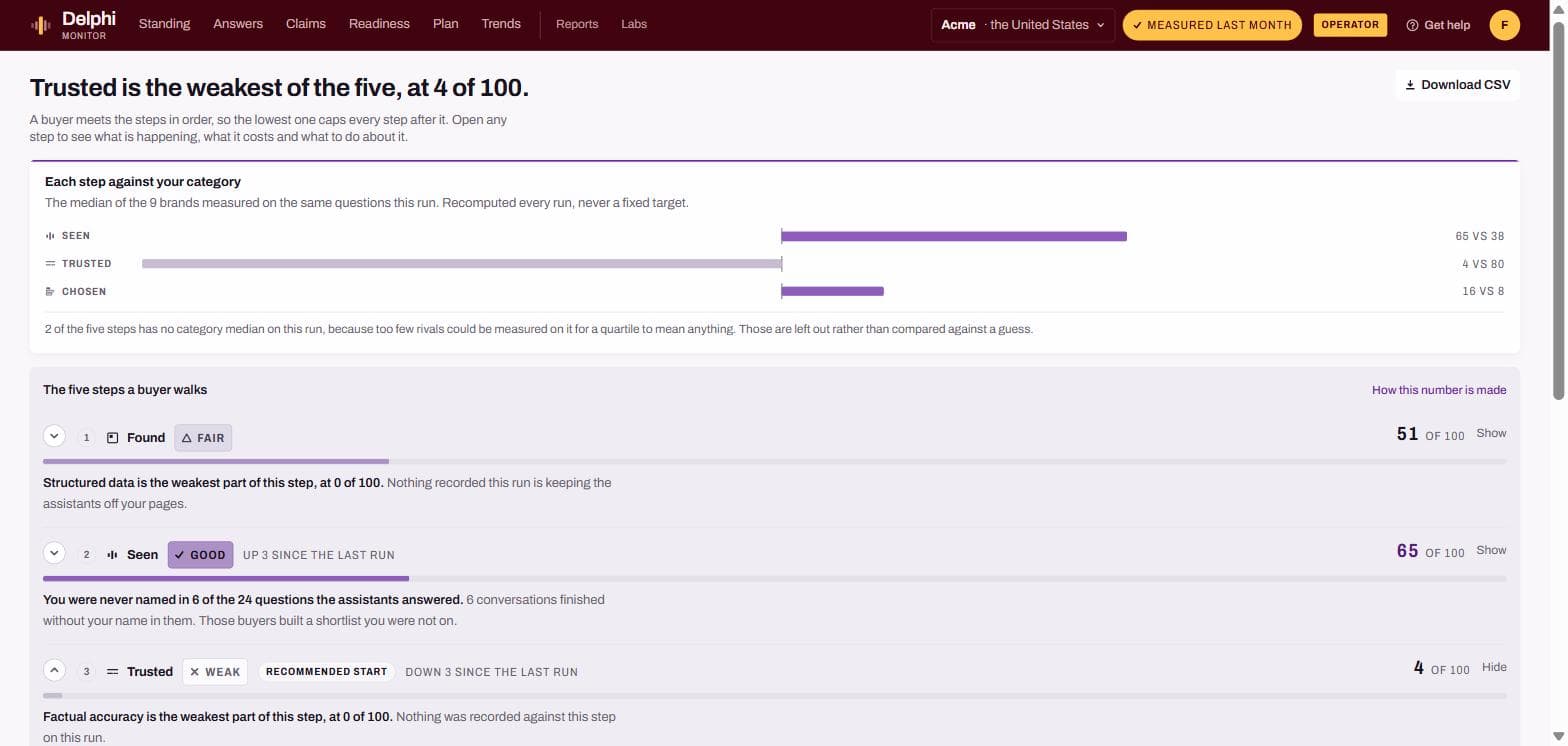
Trusted is the weakest of the five.
A buyer meets five steps in order, found, seen, trusted, chosen and bought, and the weakest one caps everything after it. There is no point working on how often you are chosen while assistants are repeating something about you that puts buyers off.
Delphi names the binding step rather than leaving you to infer it from a dashboard, and scores you against the competitors measured on the same questions, so weak means weak in your category rather than weak against an arbitrary target.
03Who is taking it
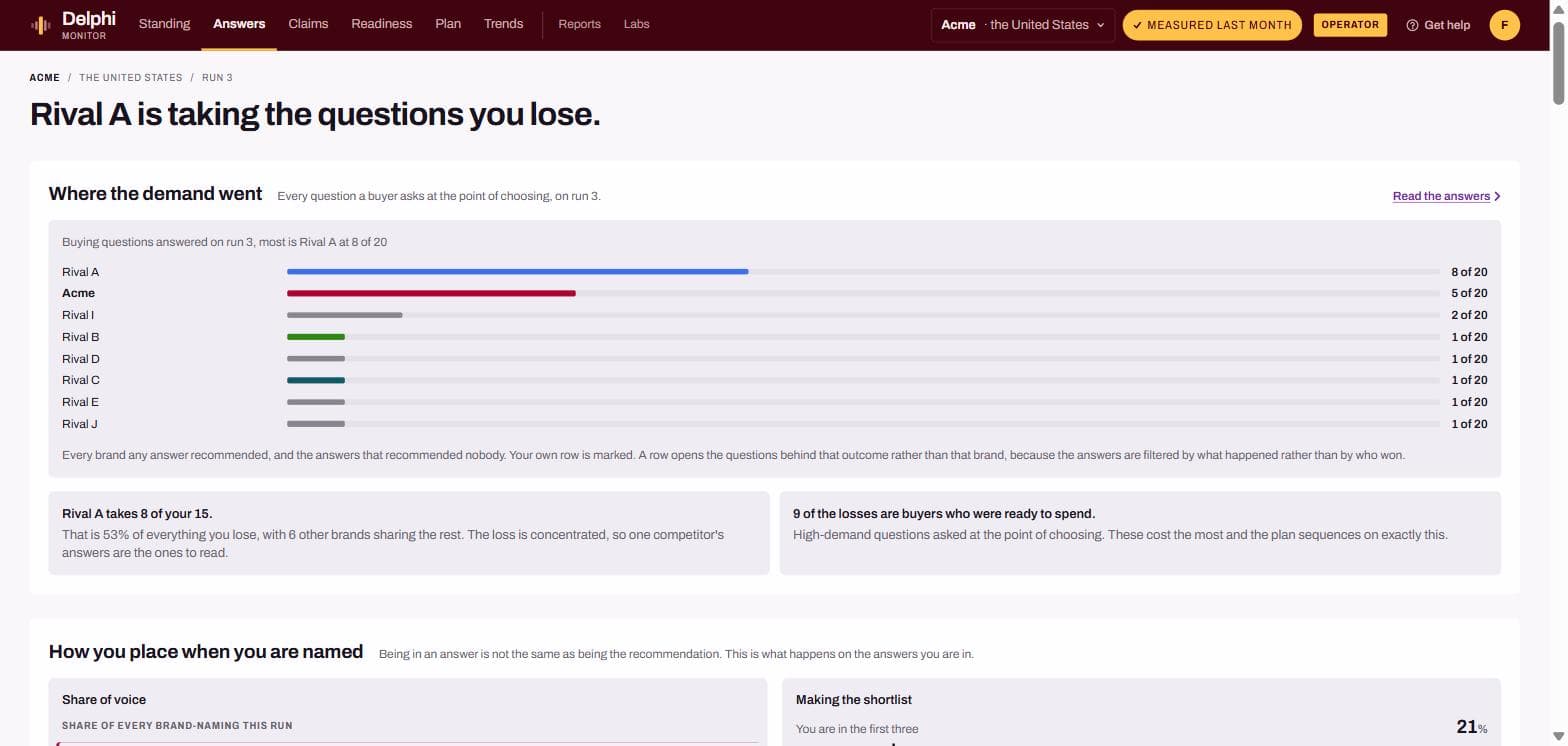
Rival A is taking the questions you lose.
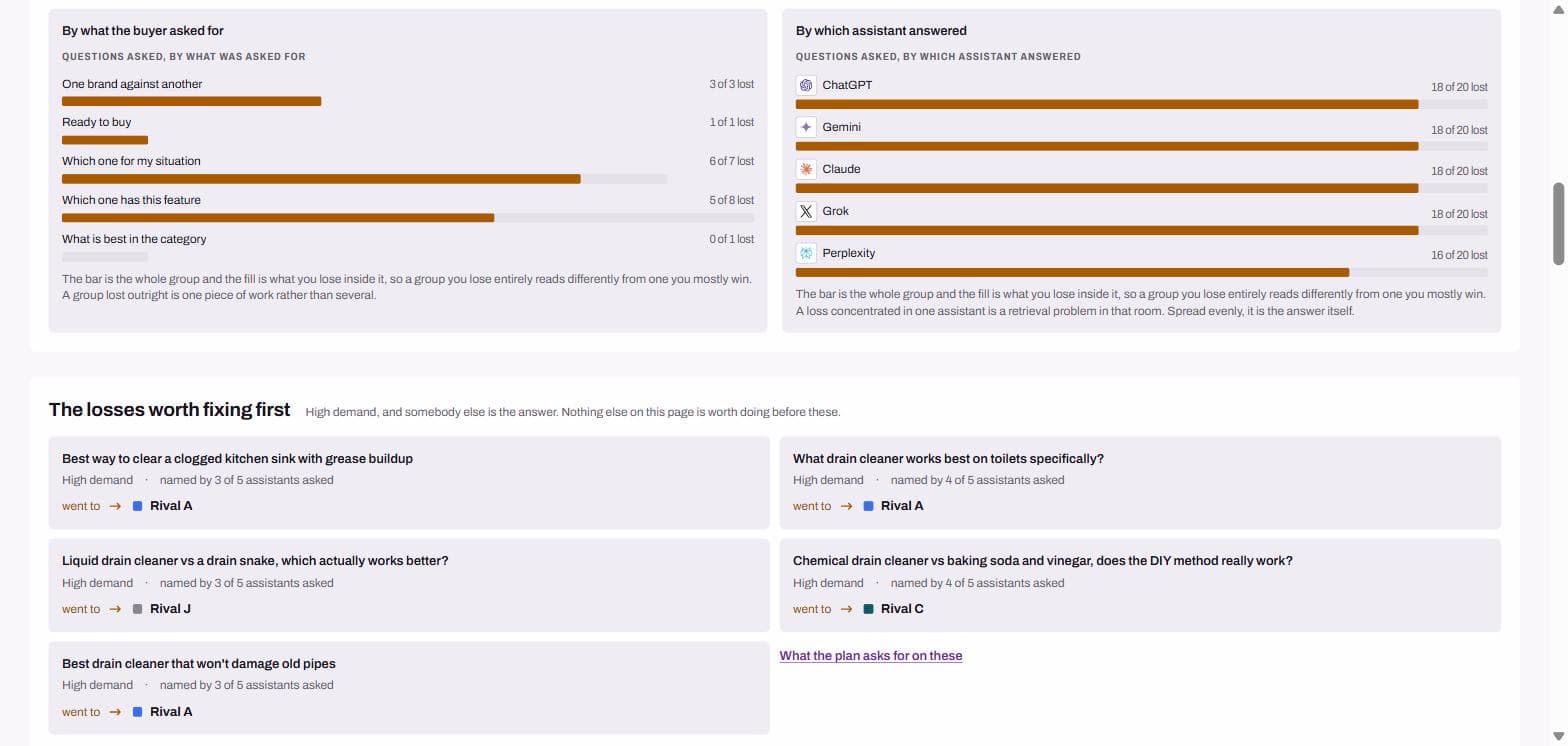
Losing is rarely spread evenly, and where it concentrates tells you what to do. Delphi shows which competitor is taking your demand, which kinds of question you lose, whether that is head to head comparisons, ready to buy questions or problem led searches, and which assistant is doing it.
That last split matters more than it looks. A loss concentrated in one assistant is a visibility problem in that one place. A loss spread evenly across all of them is your positioning, and no amount of work aimed at a single engine will fix it.
This brand holds the broad question about what is best in the category and loses the specific ones: every head to head comparison, and the questions asked by buyers ready to spend. Underneath, the questions are listed in the customer’s own words, each with the competitor that took it.
04What is being said
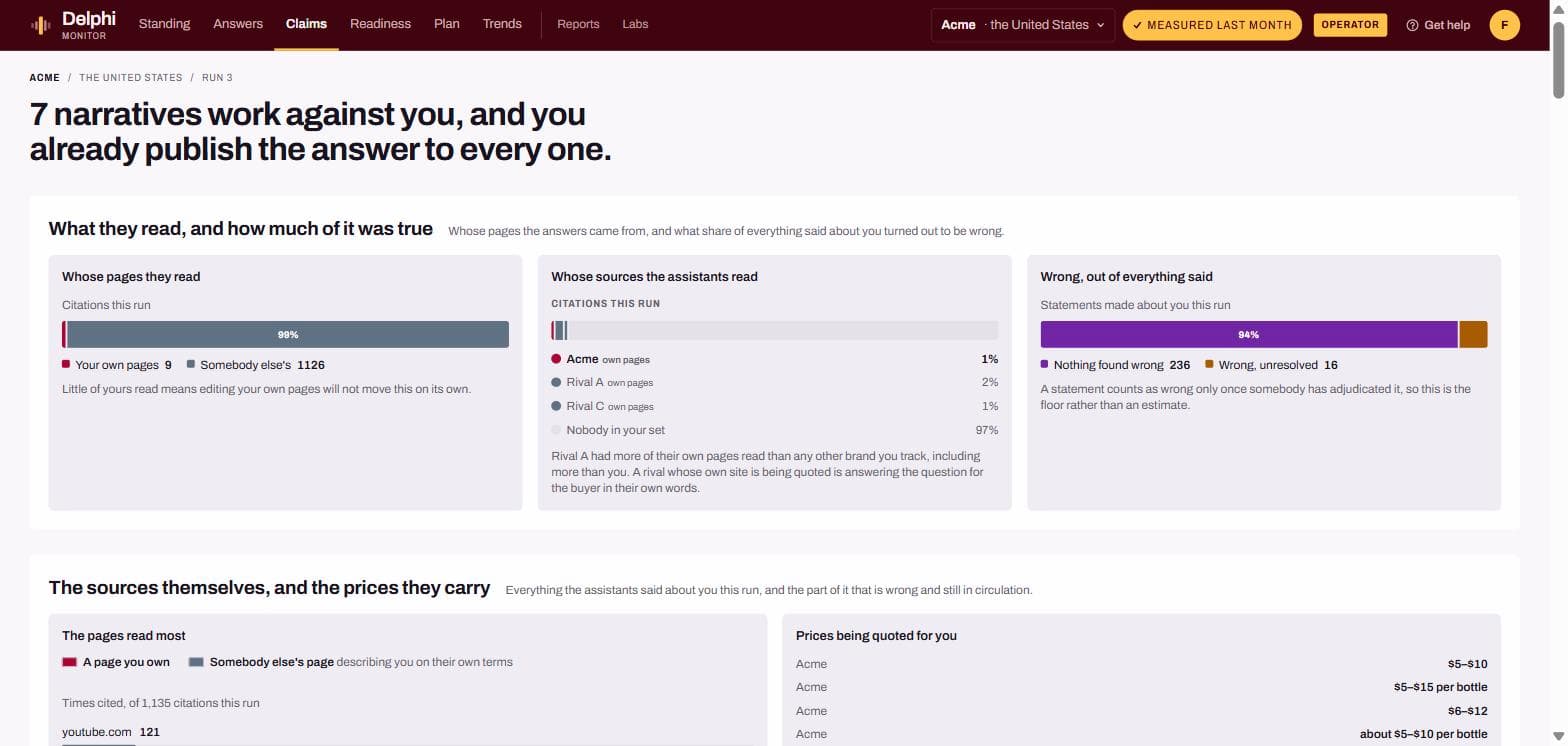
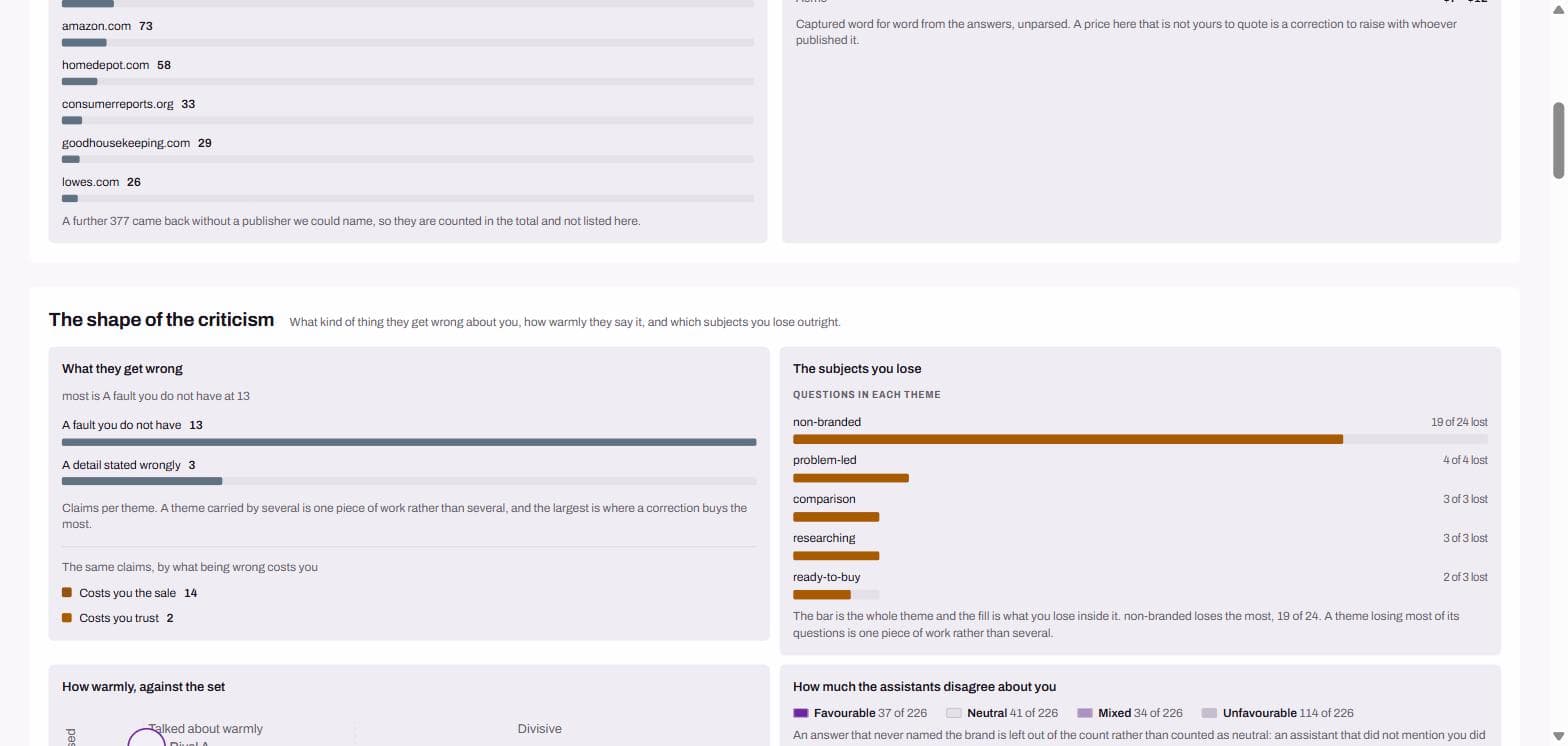
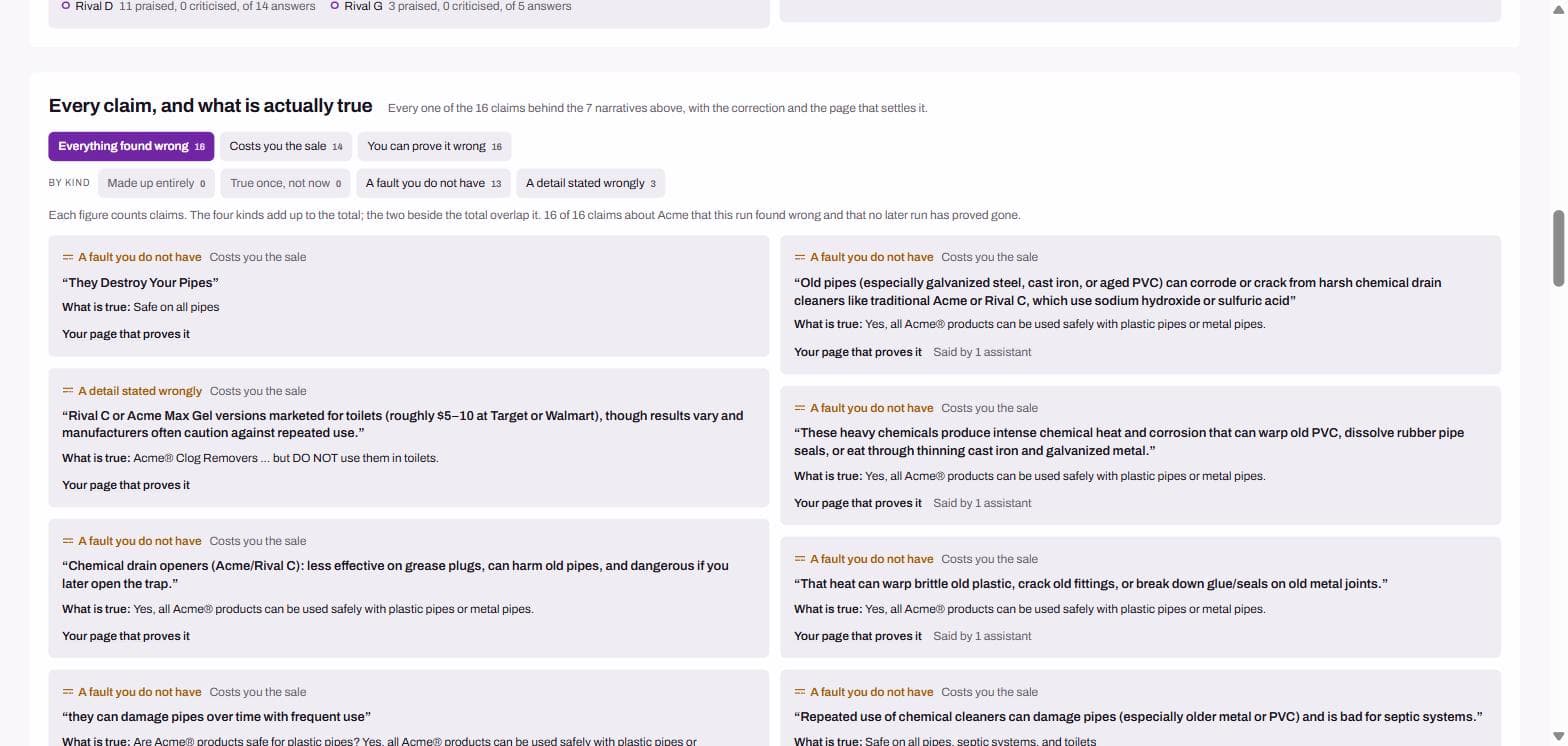
These narratives work against you, and you already publish the answer to every one.
Assistants repeat what they read, and most of what they read about you was written by somebody else. Delphi shows what is being said, whether it is actually true, and, crucially, the named websites the answers are being built from.
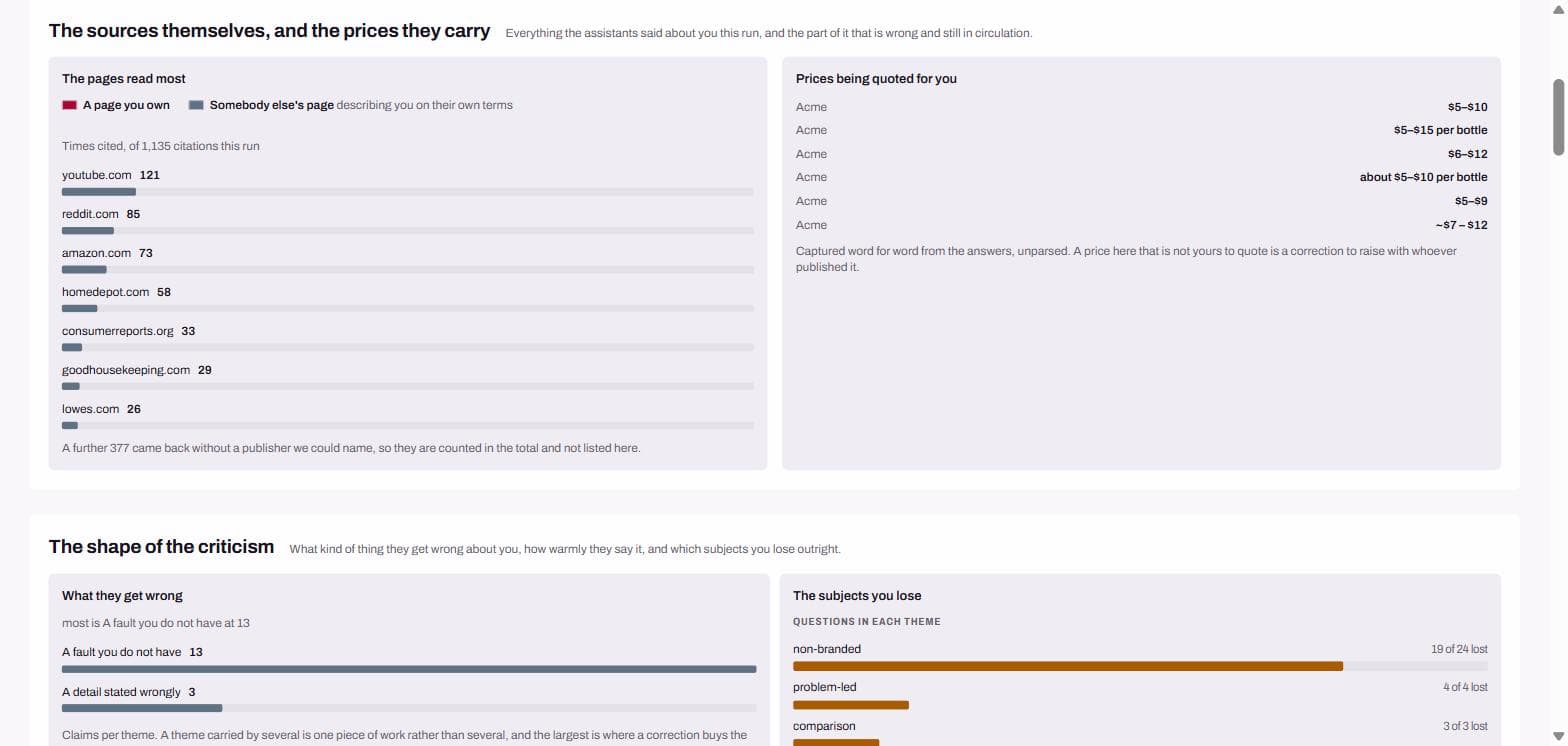
That list is an outreach plan. If the pages shaping your reputation are review sites, forums, retailers and video, then editing your own website will not move this on its own, and knowing that early saves a quarter of the wrong work.
Where something is wrong, you get the claim in the assistant’s own words, the correction, and the page on your own site that already settles it. Prices are captured the same way, so you can see what buyers are being quoted for your products by pages you do not control.
05Where it breaks
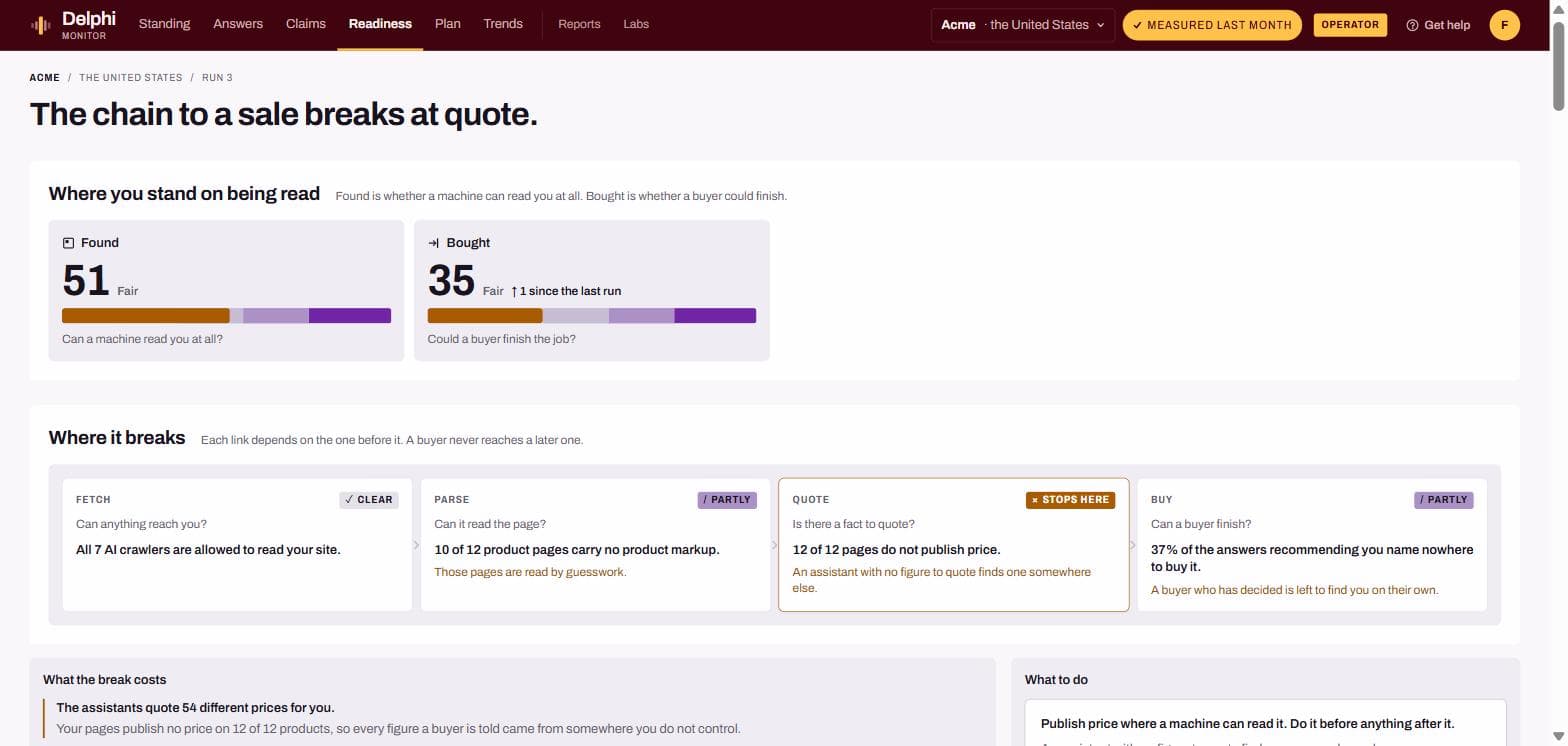
The chain to a sale breaks at quote.
This is the screen that shows a mechanism rather than a score. Each link depends on the one before it, and a buyer never reaches a later link than the one that fails, so the fix belongs where the chain breaks rather than where the pain is felt.
Here the assistants can reach the site and mostly read it, then stop: with no price they can quote from a page the brand controls, they go and find one somewhere else. Everything downstream of that is a consequence rather than a separate problem.
06What to do
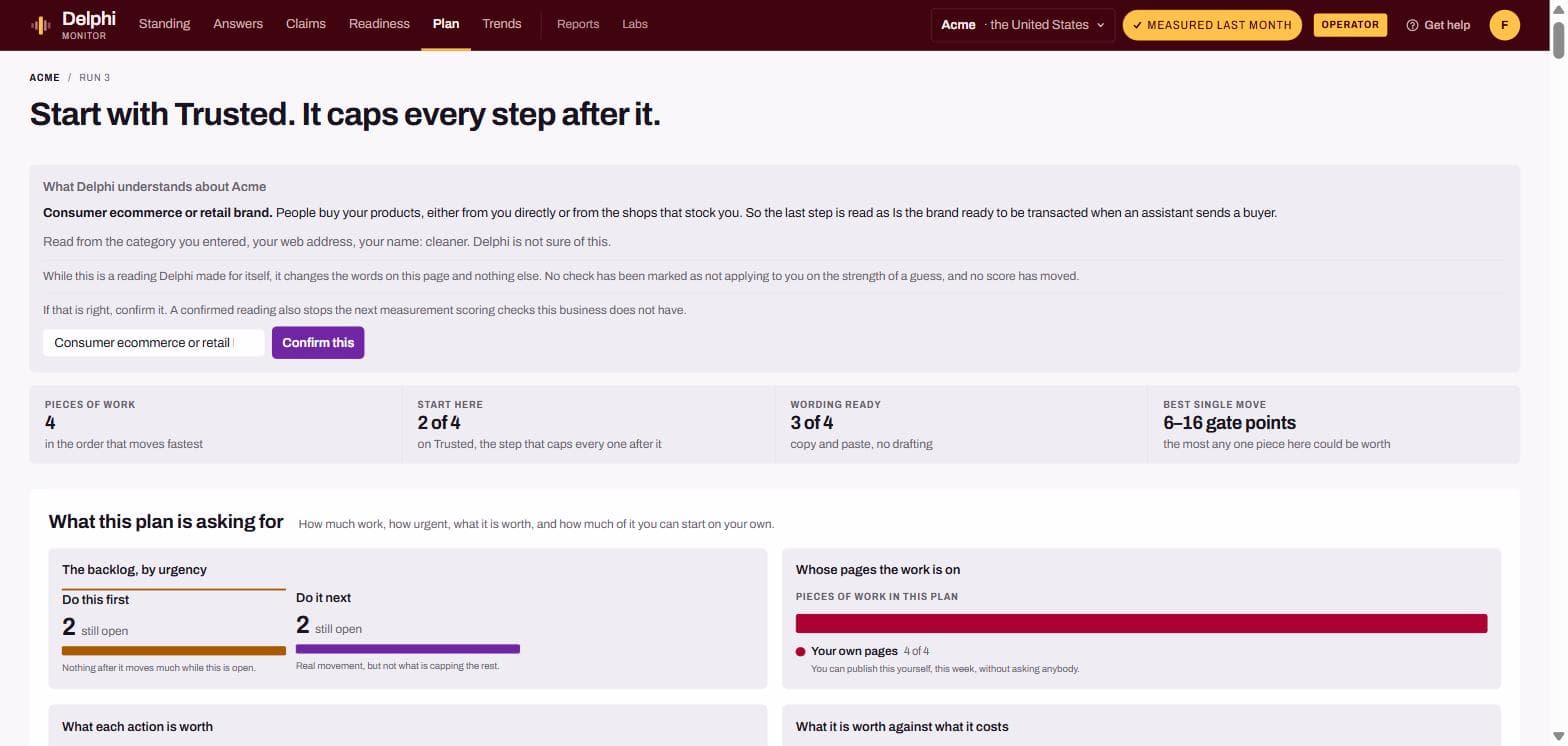
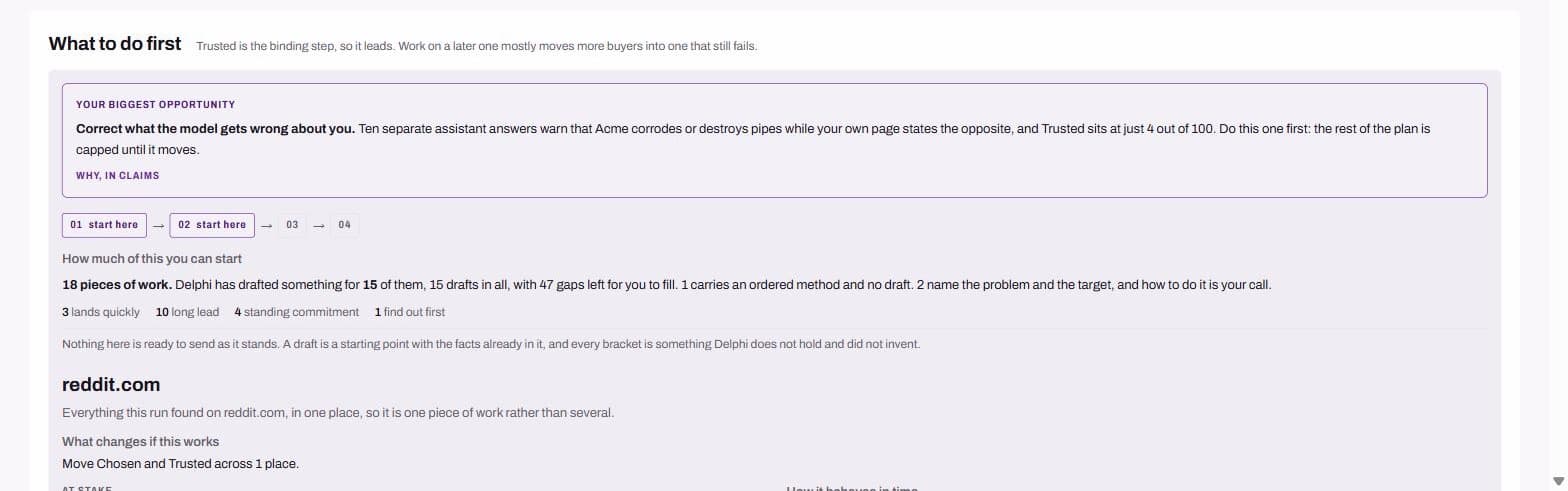
Start with Trusted. It caps every step after it.
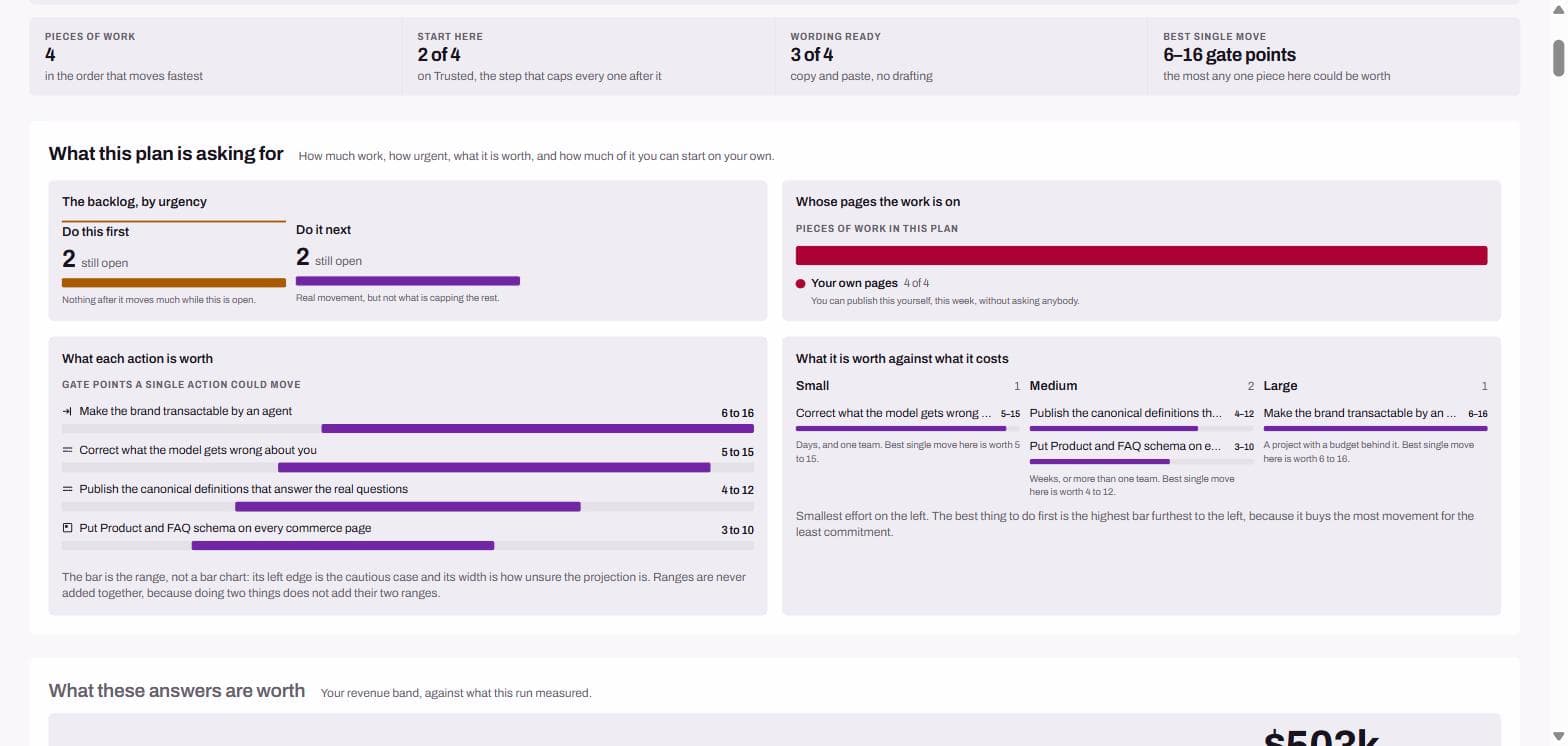
Not a list of recommendations but a sequence. The work is ordered by what will move your position fastest, and each item carries what it could be worth against what it will cost you to do, so an afternoon’s fix and a quarter’s project can be compared honestly.
Most of it, in this case, is work on pages the brand already owns and could publish this week without asking anybody’s permission. Where Delphi has drafted something for you, it says so; where it is asking you to decide something, it says that too.
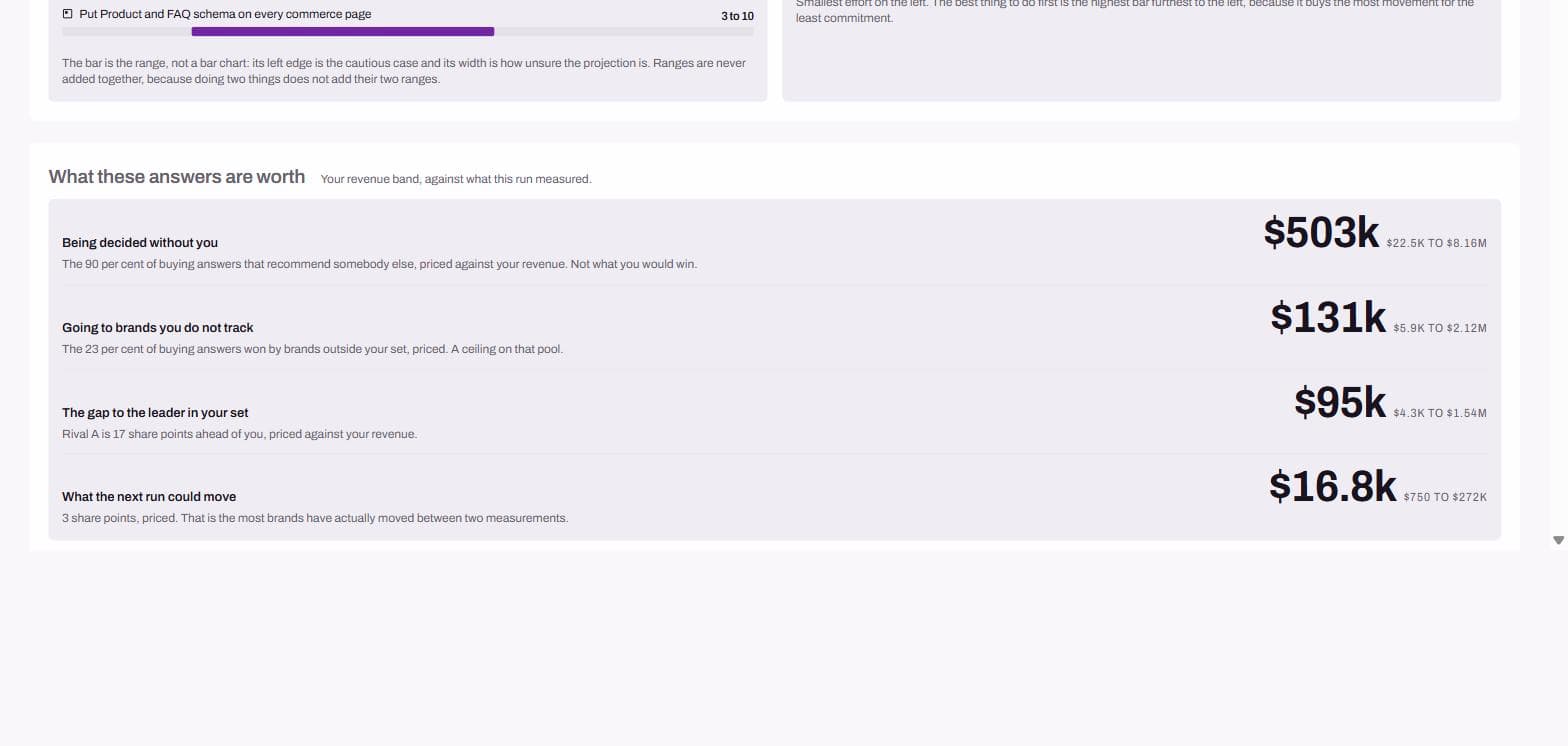
And because a share of recommendations is a share of demand, the plan prices what is currently being decided without you, so the work can be argued for in the same terms as any other spend, in front of people who do not care about visibility scores.
07Did it work
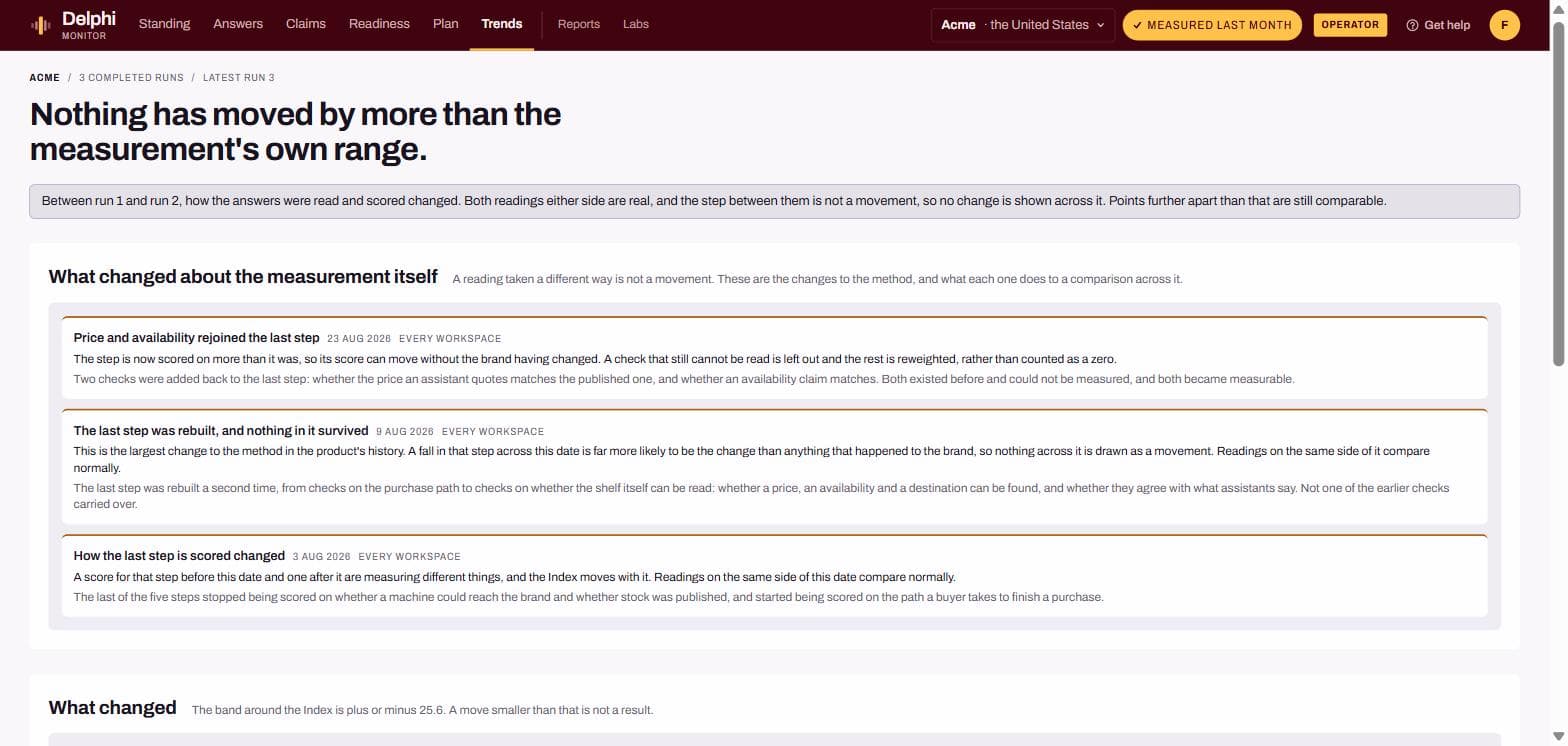
Closing the loop on what you actually changed.
This is the part most tools skip. You made a change; the next run measures whether it landed. Movement is reported against your previous runs, and only called a result when it is bigger than the measurement’s own margin of error, so you are never shown a win that was really noise.
That restraint is deliberate, and it is what makes the progress worth putting in front of a board. Over successive runs you get a record of what you did and what it moved, rather than a number that goes up and down for reasons nobody can explain.
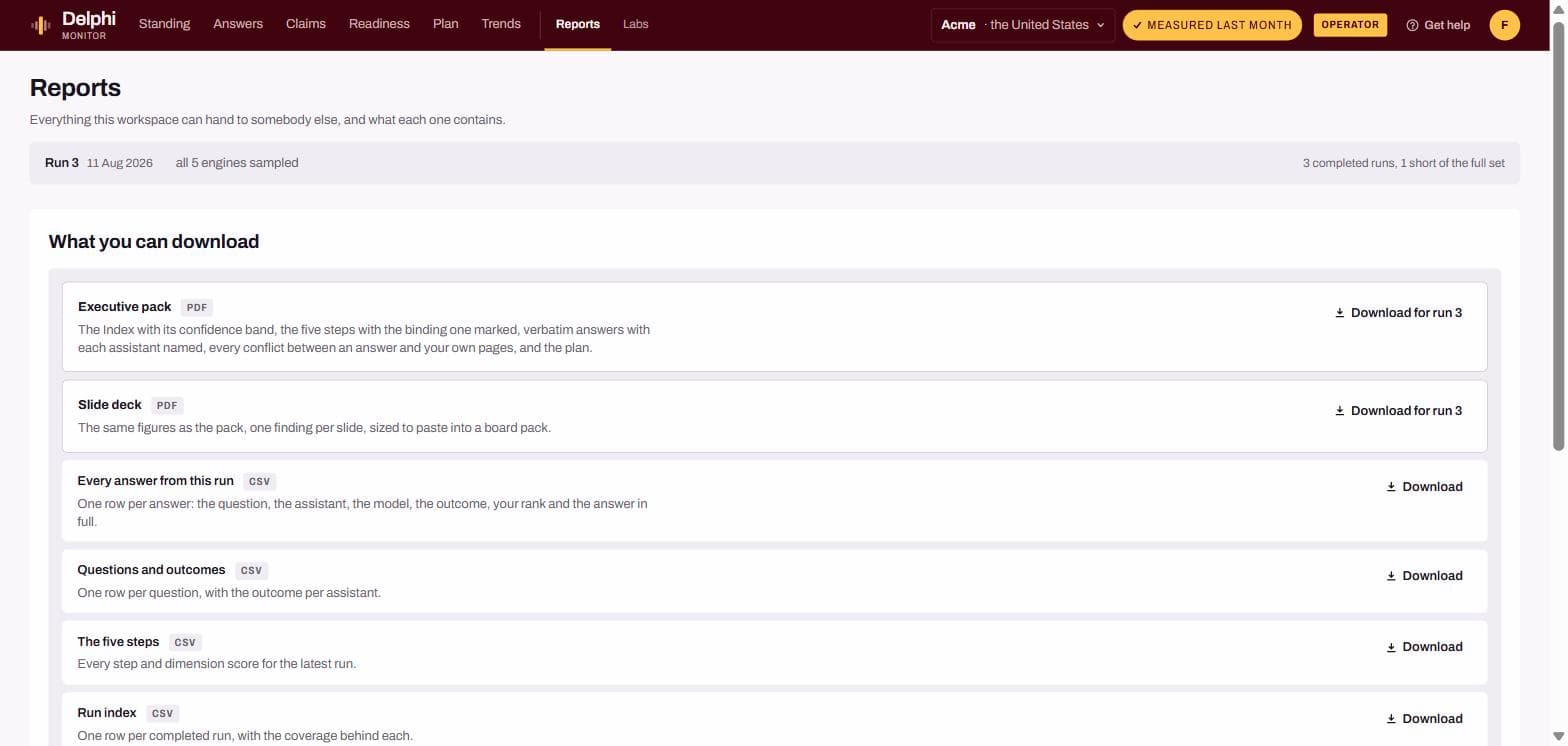
08Handing it on
Everything the workspace can give somebody else.
A pack for the people who need the conclusion, a deck for the meeting where it gets discussed, and the underlying data for anyone who wants to check the working themselves. Nothing on the earlier screens is a figure you have to take on trust.
Where you would start
Every paid level gives you everything on this page, including the plan and the loop back to whether it worked. What changes with the price is how many brands you measure and how you reach a person. Start on the smallest that covers your brands.
Starter
$99 a month
Everything on this page, on one brand. One run a month, and email when you need somebody.
Growth
$399 a month
The same, across three brands, with office hours rather than email.
Agency and Enterprise
$1,499 and up
More brands and more frequent runs, for teams running this across a portfolio.
Month to month, cancel from inside the product. A brand is one brand in one market: assistants answer differently by country, so the same brand measured in two places is two brands.
Disclaimer. Delphi Monitor is an AI powered tool. The inputs you provide, which are your category, your competitors and your questions, materially shape the quality of what comes back, so it is worth setting them up carefully. Findings and recommended actions are intended to be used directionally, as informed guidance for your own judgement, rather than as promises of an outcome.
Screens captured from a live workspace. Brand names replaced; no figure, ranking or finding altered. Results shown are specific to one brand, category and market, and are not representative of any other.